Every commerce experience today is reactive.
A customer searches. You show results. They browse. You recommend similar items. They add to cart. You send an abandoned cart email. They purchase. You upsell.
Action, reaction. Click, response. Query, answer.
It works, barely. But it's fundamentally backwards.
By the time a customer asks for something, they've already spent cognitive effort figuring out what they need, how to articulate it, and where to find it. You're not creating value—you're responding to friction they've already experienced.
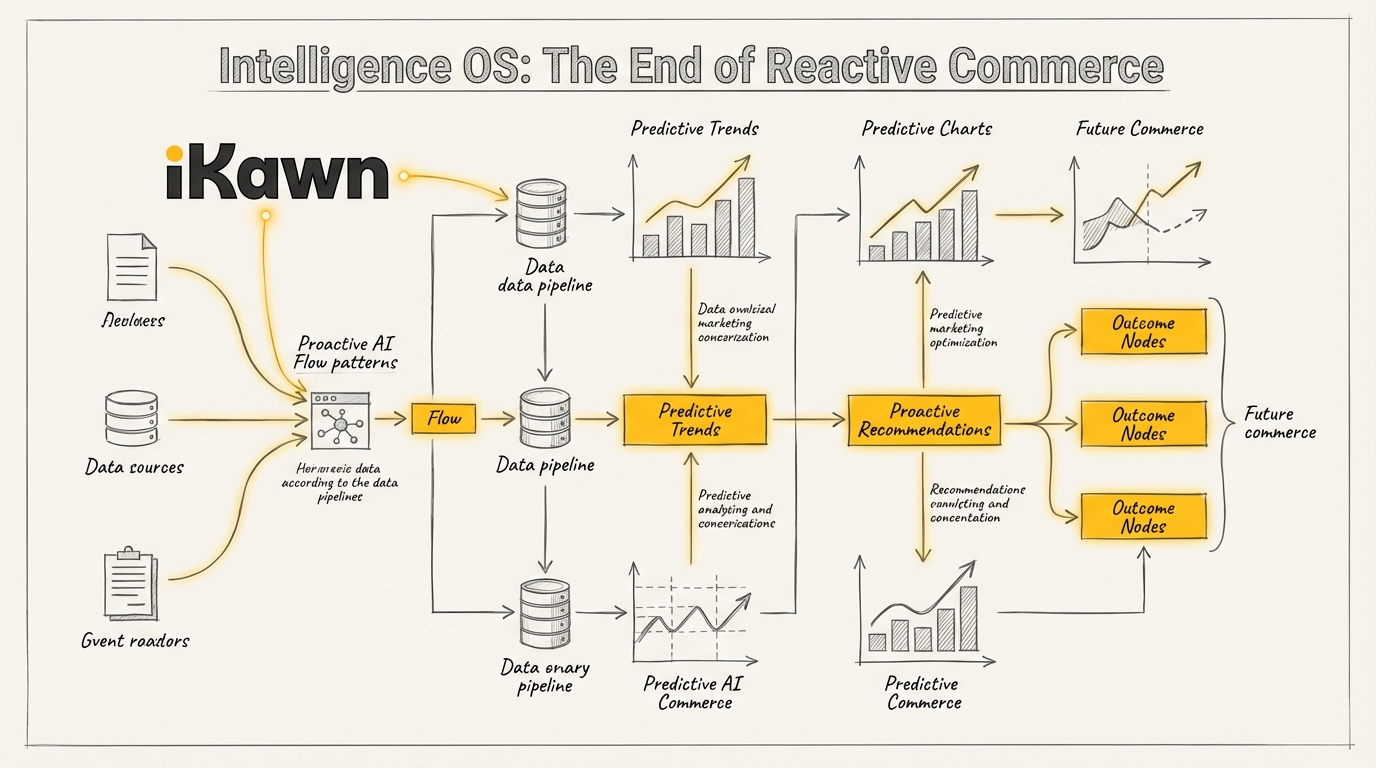
Intelligence OS inverts this. Instead of reacting to expressed needs, it predicts unexpressed intent and fulfills it proactively.
The Problem: We've Optimized Reaction Speed, Not Anticipation
Most commerce platforms compete on response time. Faster search. Quicker checkout. Instant recommendations.
This treats the customer journey as a series of discrete requests:
- Customer wants something
- Customer tells you what they want
- You deliver it
- Repeat
But every step in this loop is friction:
- Figuring out what you want requires effort
- Articulating it requires precision ("winter coat" vs "insulated parka for commuting in sub-zero temps")
- Navigating results requires filtering, comparing, deciding
Even the best reactive system makes customers do work.
Intelligence OS eliminates steps 1 and 2. It predicts what you'll need before you search for it, then surfaces it contextually so the decision becomes binary: yes or no.
How Intelligence OS Works: Predictive Intent Modeling
At its core, Intelligence OS builds a forward-looking model of customer behavior. Instead of asking "what did this customer do?", it asks "what will they need next?"
Here's how:
1. Temporal Pattern Recognition Most customers exhibit predictable patterns over time:
- Seasonal purchasing (winter coats in November, swimwear in May)
- Replenishment cycles (coffee every 3 weeks, skincare every 2 months)
- Life stage triggers (new baby → diapers, bottles, stroller)
- Event-driven needs (holiday shopping, moving, starting a job)
Intelligence OS doesn't wait for the search. It predicts the need window and pre-surfaces options.
A customer who buys running shoes every 6 months gets a "time for new shoes?" prompt at month 5.5, with their preferred brands and last purchase size pre-loaded. No search. No browsing. One click to re-order or explore alternatives.
2. Cross-Domain Intent Inference The most valuable predictions come from signals outside your platform.
Someone searches for "remote work desk setup" on Google, then lands on your furniture site. Traditional systems show desks. Intelligence OS infers: they're setting up a home office. They'll also need a chair, monitor stand, cable management, and lighting.
Instead of waiting for five separate searches, it shows a curated "remote work essentials" bundle, tailored to their style preferences from browsing behavior and budget signals from cart history.
Same logic applies across industries:
- Healthcare: predict follow-up appointment needs based on treatment timelines
- Education: predict when a student will struggle based on engagement patterns and topic complexity
- B2B: predict when a customer will need to upgrade based on usage growth and feature limits
3. Contextual Need Anticipation Intelligence OS factors in real-time context:
- Weather (rain forecast → suggest umbrellas, waterproof gear)
- Location (near a store → offer in-store pickup with instant availability)
- Time of day (late night browsing → surface quick-ship items for impulse conversion)
- Device (mobile in transit → prioritize mobile-optimized experiences and saved payment methods)
The system doesn't just know what you might want—it knows when and how you'll want it.
4. Outcome Prediction and Pre-Optimization Most platforms optimize for clicks and conversions. Intelligence OS optimizes for outcomes beyond the transaction:
- Satisfaction (will this purchase meet their actual need, or will it get returned?)
- Retention (will this drive long-term loyalty or one-off engagement?)
- Lifetime value (does this move them toward higher-tier purchasing or dilute their brand perception?)
If the model predicts low satisfaction (based on similar customers' return rates for this product), it surfaces alternatives or adds context to set expectations. If it predicts this is a gateway purchase to higher LTV (starter product in a category they'll expand into), it optimizes for education and onboarding, not immediate upsell.
The Technical Foundation: Multi-Modal Predictive AI
Intelligence OS combines:
- Behavioral models (what customers do)
- Temporal models (when they do it)
- Contextual models (why they do it)
- Outcome models (what happens after)
Each runs continuously, updating predictions in real-time as new signals arrive.
The breakthrough is treating intent prediction as a sequential problem, not a classification problem. We're not asking "is this customer interested in product X?"—we're asking "given their history and current context, what sequence of needs will they have over the next 30-90 days?"
This requires:
- Transformer-based architectures that capture long-term dependencies
- Multi-task learning that optimizes for multiple outcomes simultaneously
- Reinforcement learning that adapts based on prediction accuracy
- Real-time inference that runs sub-100ms per session
Five years ago, this would've required data center-scale compute per customer. Today, edge AI and model compression make it economically viable at scale.
What This Unlocks: From Search to Discovery
Most commerce experiences are search-driven. You know what you want, you search for it, you buy it.
Intelligence OS enables discovery. You don't know you need something until the system shows you, and the timing is so precise that it feels obvious in hindsight.
Early applications:
- Proactive replenishment: "Looks like you're running low on X. Reorder now?"
- Lifecycle anticipation: "Based on your recent purchase, you'll need Y in 2 weeks. Add it now to save on shipping?"
- Contextual recommendations: "Weather forecast shows rain this weekend. Here are waterproof options based on your style."
But the endgame is bigger: a commerce experience where searching becomes rare because the system already knows.
Beyond Commerce: Intelligence Across Industries
We're starting with ecommerce because feedback loops are immediate. But predictive intelligence applies anywhere decisions happen over time:
Healthcare: Predict patient non-adherence to medication based on refill patterns and engagement signals. Intervene before they lapse.
Finance: Predict cash flow gaps for small businesses based on transaction history and seasonality. Offer bridge financing proactively.
Education: Predict when a student will disengage based on assignment completion trends and peer benchmarking. Surface support resources before they drop out.
Real Estate: Predict when a renter will look to buy based on income growth, browsing behavior, and life stage signals. Surface mortgage pre-qualification and listings proactively.
The pattern is the same: monitor temporal signals, predict future state, intervene before friction becomes failure.
The Risks: Prediction Without Presumption
Predictive systems have a creep factor if done wrong.
The difference between "helpful" and "invasive" is transparency and control.
Intelligence OS operates on a simple principle: predictions are suggestions, not mandates.
If the model predicts you'll need winter boots, it surfaces them as an option. You can ignore, dismiss, or engage. The system learns from your response and adjusts future predictions accordingly.
If you consistently ignore a category of predictions, it stops surfacing them. If you engage heavily, it refines and expands.
The goal isn't to make decisions for customers—it's to reduce the effort required to make good decisions.
What's Next: Closed-Loop Intelligence
Intelligence OS is the third layer of our stack:
- Visual OS generates adaptive imagery
- Personalization OS assembles individualized experiences
- Intelligence OS predicts what comes next and pre-optimizes
Together, they form a closed loop:
- Visual OS shows contextually relevant product imagery
- Personalization OS tailors the experience to individual preferences
- Intelligence OS predicts the next need and surfaces it proactively
- Customer engages (or doesn't), feeding signals back into all three systems
- Loop repeats, continuously improving
The system gets smarter every session. Not just for one customer—every interaction improves the model for everyone.
The Bigger Vision: Operating System for Decisions
We call it Intelligence OS because it's not just a feature—it's infrastructure.
In the same way that iOS and Android became platforms for mobile apps, Intelligence OS becomes the platform for decision-making across commerce, healthcare, finance, education, and beyond.
Developers build on top. We provide the predictive layer. Customers get better experiences. Everyone wins.
We're starting with commerce because it's the easiest to prove. Transactions are binary. You convert or you don't. Predictions are testable within minutes.
But once the foundation is solid, the applications are nearly limitless.
Every decision that happens over time—every repurchase, every renewal, every reorder, every follow-up—can be predicted and optimized.
The brands and platforms that get there first will own the next decade. The ones that stay reactive will become invisible.
We're building the former.