Here's what most companies call personalization:
"Hi [First Name], we noticed you're a [Segment] in [Location]. Here's an offer for [Category You Browsed Once]."
It's mail merge with extra steps. And customers see right through it.
The problem isn't that brands don't want to personalize—it's that they're stuck with tools built for segments, not individuals. You divide your audience into buckets (millennials in urban areas who browsed shoes), assign each bucket a variant (email A, landing page B), and hope the averages work out.
This approach breaks down the moment you realize two people in the same segment have completely different needs.
Both are "female, 25-34, urban, browsed sneakers." One is a nurse buying comfortable work shoes. The other is a sneakerhead collecting limited drops. Same segment. Opposite intent. Your "personalized" email flops for both.
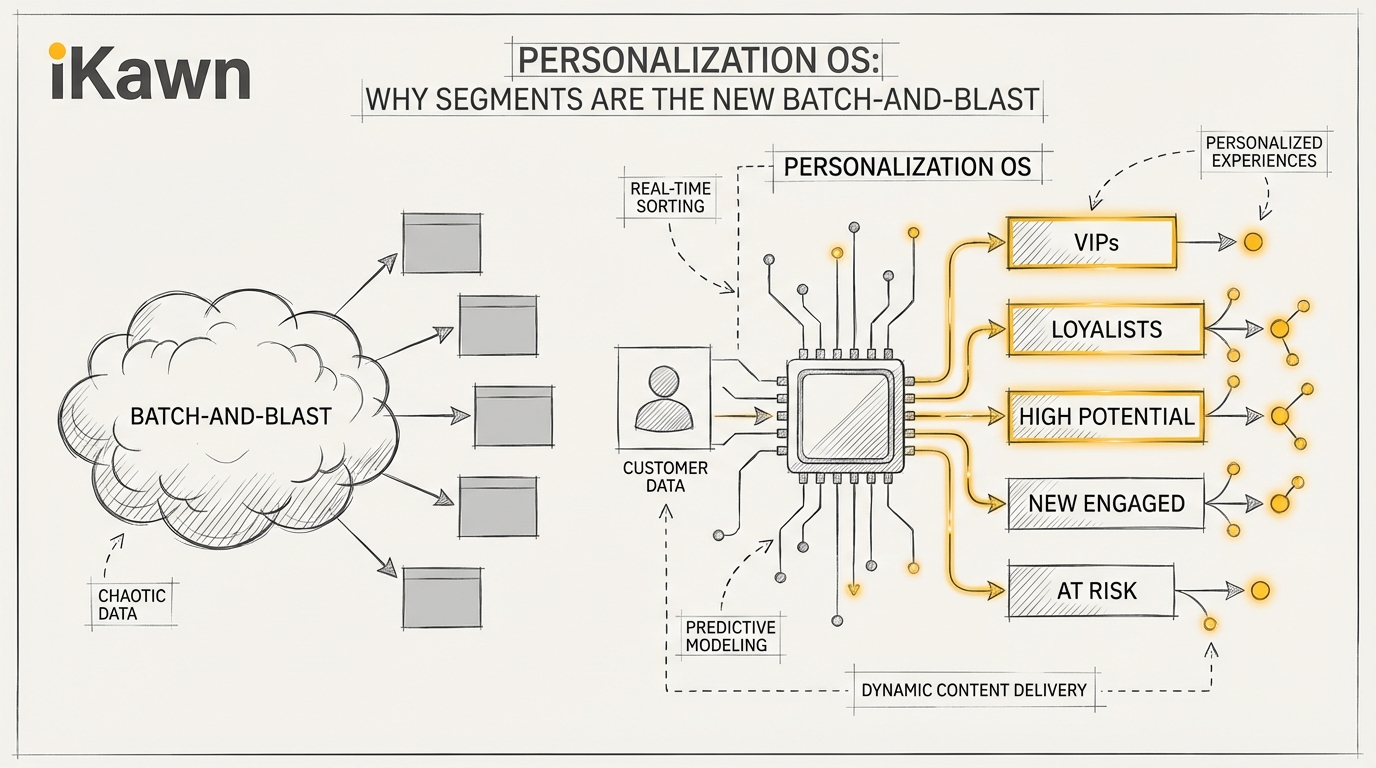
Personalization OS solves this by treating every customer as a segment of one.
The Flaw in Segmentation: Averages Obscure Individuals
Segmentation made sense when compute was expensive and data was sparse. You couldn't personalize for millions of individuals, so you grouped them by demographics and behaviors, then optimized for the average of each group.
But averages hide the variance that matters most.
Consider a "high-value customer" segment. You might define it as "purchased 3+ times in the last 6 months, AOV >$200." Now ask: what do they actually have in common?
One customer buys quarterly because they're stocking up on essentials—predictable, low-touch, price-sensitive.
Another buys impulsively whenever they see something new—erratic, high-touch, willing to pay premium for novelty.
A third buys gifts for others—seasonal spikes, different taste profile than their own purchases, values convenience over price.
Same segment. Completely different customer journeys. If you send all three the same "VIP early access" email, you'll convert one and annoy two.
The issue compounds when you layer segments. "High-value + browsed shoes + located in NYC + opened last email" sounds hyper-targeted. But you're still bucketing dozens or hundreds of people based on surface signals, then averaging their preferences.
Personalization OS doesn't bucket. It models each customer individually, then adapts in real-time.
How Personalization OS Works: Individual Models at Scale
Instead of assigning customers to segments, Personalization OS builds a lightweight model for each person based on:
Behavioral signals: What they click, how long they linger, what they abandon, when they convert Contextual signals: Device, location, time of day, referral source, session depth Historical patterns: Purchase frequency, category preferences, price sensitivity, content engagement Predictive indicators: What similar customers did next, what typically drives conversion, what's trending now
The system doesn't guess your segment. It predicts your next action.
Here's what that enables:
1. Dynamic Experience Assembly Every page is assembled in real-time based on what's most likely to drive the outcome you're optimizing for—conversion, engagement, retention, AOV.
A first-time visitor sees trust signals, social proof, and broad category exploration. A repeat customer skips the intro and sees new arrivals in their preferred categories. Someone who abandoned cart twice sees urgency cues and financing options.
Same URL. Different page. No manual variant creation.
2. Adaptive Messaging and Offers Personalization OS doesn't just swap headlines. It adjusts the entire narrative.
A price-sensitive customer sees value props, bulk discounts, and price-match guarantees. A quality-focused customer sees craftsmanship details, materials, and warranties. An impulsive buyer sees limited stock, trending products, and one-click checkout.
The model learns from every interaction. If urgency cues backfire for a specific customer (they bounce), the system stops using them. If long-form content drives engagement (they scroll and click), it serves more.
3. Cross-Channel Continuity Most personalization tools operate in silos. Your website knows one thing. Your email platform knows another. Your ads know a third. The customer experiences disjointed fragments.
Personalization OS maintains a unified model across every touchpoint. If someone browses winter coats on desktop, then opens an email on mobile, the email content reflects that intent. If they click an ad after abandoning cart, the landing page picks up where they left off.
No more starting over every channel. The experience flows.
4. Outcome-Based Optimization Here's where it gets interesting: you can optimize for different outcomes per customer.
For a high-LTV customer, you optimize for retention and satisfaction, even if it means lower short-term revenue. Show them honest reviews, recommend complementary products, offer white-glove support.
For a deal-seeker, optimize for conversion volume. Show best-sellers, highlight discounts, streamline checkout.
For a lapsed customer, optimize for re-engagement. Surface new categories they haven't tried, offer a win-back incentive, remind them why they shopped before.
Same platform. Different goals. Personalized outcomes.
Beyond Commerce: Personalization at Enterprise Scale
We're focused on ecommerce because transactions create tight feedback loops—you know immediately if personalization worked. But the same principles apply across industries.
Healthcare: Patient portals could adapt based on health literacy, condition complexity, and engagement history. A newly diagnosed patient sees educational content and support resources. A long-term patient managing a chronic condition sees treatment tracking and lifestyle tips.
Education: Learning platforms could adjust content difficulty, pacing, and format based on individual progress and learning style. Visual learners get diagrams and videos. Analytical learners get data and frameworks.
B2B SaaS: Product tours and dashboards could adapt based on role, team size, and usage patterns. A solo founder sees getting-started flows. An enterprise admin sees governance controls and integration options.
The moment you have multiple touchpoints and diverse customer needs, personalization becomes a competitive advantage.
Why This Works Now: The AI Advantage
Personalization at individual scale has always been the goal. The challenge was compute cost and model complexity.
Traditional rules-based personalization required someone to write: "If user is in segment A AND did action B AND time is C, show variant D." You'd need thousands of rules to cover meaningful scenarios, and they'd conflict, degrade, and become unmaintainable.
Machine learning-based personalization (circa 2015) helped, but still relied on segmentation under the hood. You'd cluster users, train a model per cluster, then assign new users to the closest cluster. Better than rules, but still averaging.
Modern AI changes the game:
- Foundation models understand context and intent without manual feature engineering
- Real-time inference costs dropped 100x in three years
- Edge compute enables sub-50ms personalization without server latency
Now you can run a unique model per user, update it continuously, and serve personalized experiences at scale without breaking the bank.
What This Unlocks: From Batch to Real-Time
Most brands still personalize in batches. They segment users weekly, assign them to campaigns, and hope the segments stay accurate.
Personalization OS operates in real-time. Every interaction updates the model. Every session is personalized from the first click.
Early customers see:
- 25-40% lift in conversion rates (individual targeting beats segment averages)
- 30-50% improvement in email engagement (content matches actual intent)
- 60-80% reduction in wasted ad spend (stop targeting the wrong people)
But more importantly, customers stop feeling like they're being "marketed to" and start feeling understood.
The Bigger Picture: Personalization as Infrastructure
Personalization OS sits between Visual OS and Intelligence OS in our stack.
Visual OS makes every image adaptive. Personalization OS makes every experience adaptive. Intelligence OS makes the entire system predictive.
Together, they form a closed loop:
- Visual OS generates contextual imagery
- Personalization OS assembles the optimal experience
- Intelligence OS predicts what comes next and pre-optimizes
We're building the operating system for intelligent commerce—starting with ecommerce, expanding to any industry where individual preferences drive outcomes.
Segmentation made sense when compute was expensive. Now that it's cheap, treating customers as individuals isn't just possible—it's table stakes.
The brands that get there first win. The ones that don't become background noise.