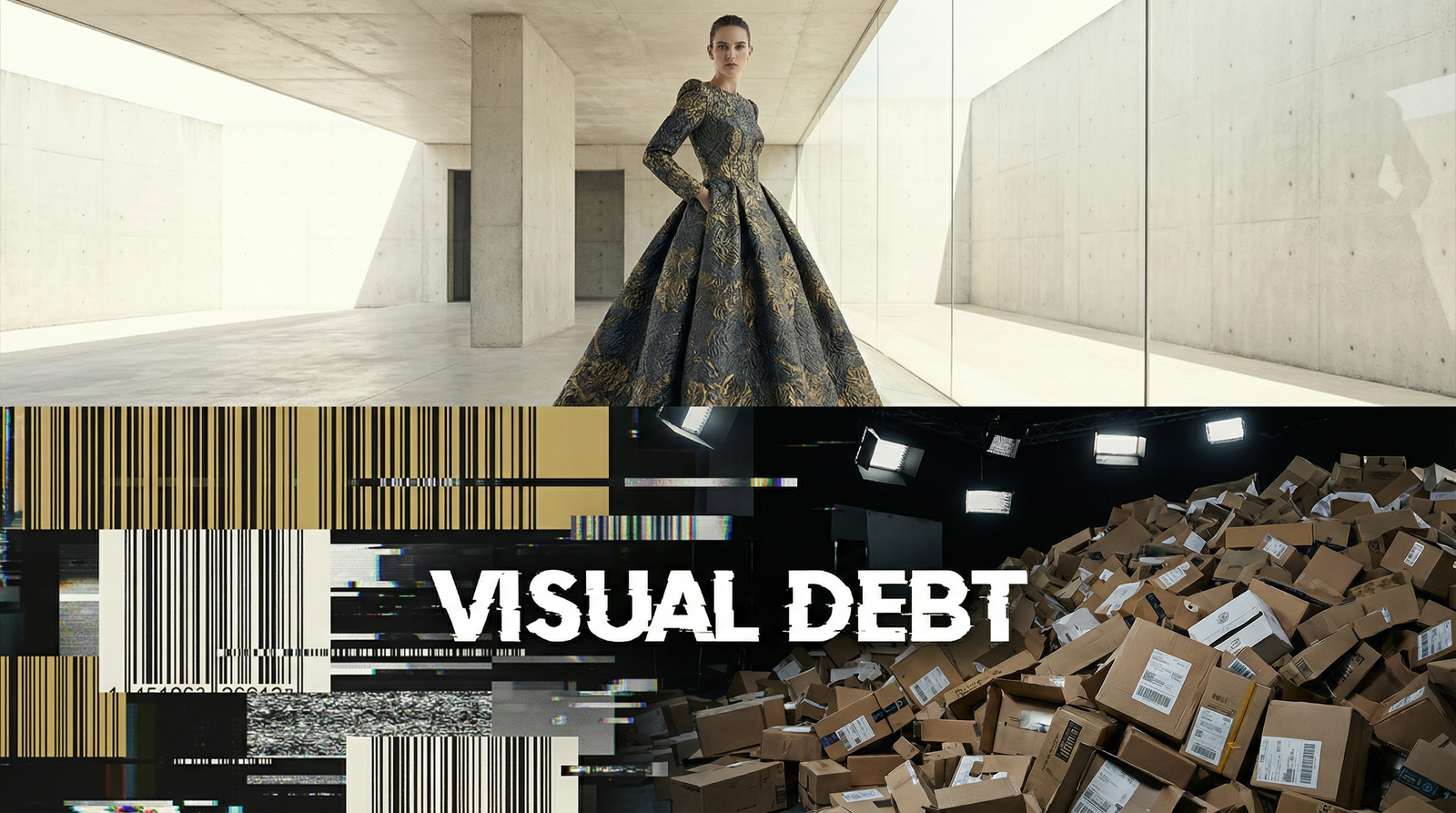
Return rates are destroying fashion eCommerce economics. The average fashion brand sees 20-30% returns, but the real number for online-only purchases can hit 40-50%. Every returned item costs $10-$30 to process, and 30% of returns can't be resold at full price.
Most brands treat this as a customer experience problem or a logistics challenge. It's neither. It's a visual debt problem.
Visual debt is the gap between how customers expect your product to look, feel, and fit versus what actually arrives. Every ambiguous product image, every missing angle, every context-free studio shot against white backgrounds creates visual debt. And like technical debt in software, visual debt compounds until it breaks your economics.
What Creates Visual Debt
Insufficient Visual Information: Three images of a jacket on a white background tell customers almost nothing about fit, drape, or styling. They guess. Guesses become returns.
Context-Free Presentation: A dress floating on a hanger looks nothing like it does worn. Customers imagine. Imagination rarely matches reality.
Static Imagery: One body type, one angle, one styling approach. But your customers are diverse. They project themselves onto imagery that doesn't represent them. Mismatch equals return.
Slow Visual Iteration: By the time you shoot, edit, and publish product photos, your product may have changed. Specs drift, fabric batches vary, fits evolve. Your visuals lag reality.
Inconsistent Visual Language: Your summer collection was shot in bright natural light. Fall was studio. Winter was lifestyle. Spring was lifestyle again but different photographer. Customers can't calibrate expectations when your visual language shifts constantly.
Each gap accumulates. A 2% increase in visual ambiguity might drive a 5% increase in returns. Across hundreds of SKUs, this compounds into millions in destroyed value.
Why Traditional Solutions Don't Work
Brands typically respond by shooting more. More angles, more models, more lifestyle contexts. This works until you do the math:
- 500 SKUs × 10 images per SKU × $50 per image = $250,000
- Still only covers your current catalog
- Still takes 6-12 weeks to execute
- Still shows limited contexts
- Still can't personalize to customer segments
- Still becomes outdated the moment you shoot
You're throwing money at a linear problem hoping for exponential results. It doesn't scale.
The Intelligence Approach to Visual Debt
The only way to eliminate visual debt is to make visual content generation as fast as the changes that create it. Not faster photoshoots. Fundamentally different infrastructure.
Generative Visual Systems: Instead of shooting every product in every context, you generate the visual permutations customers need to make confident decisions. Show the jacket in 10 different lifestyle settings. Show the dress on 5 different body types. Show the shoes in both casual and formal contexts.
Adaptive Presentation: Different customers have different visual requirements. Someone shopping for work clothes needs professional context. Someone buying for travel needs versatility context. Same product, different visual presentation, generated on-demand.
Continuous Visual Updates: When your product specs change, your visuals update automatically. When you discover returns are driven by fit confusion on a specific SKU, you generate clarifying angles immediately, not in next quarter's photoshoot.
Learned Brand Language: The system learns your brand's visual identity—lighting, composition, styling patterns—and maintains consistency automatically across thousands of generated images. Your visual language becomes codified, not dependent on individual photographer interpretation.
What This Actually Looks Like in Practice
A mid-market fashion brand ($12M annual revenue) was seeing 32% return rates and spending $180K annually on product photography. Timeline from product ready to images live: 4-6 weeks.
They shifted to a generative visual system:
Month 1-2: Trained system on existing brand photography, generated initial variations for 100 SKUs
Month 3: Expanded to full 400 SKU catalog, A/B tested traditional vs. generated lifestyle imagery
Month 6 Results:
- Return rates dropped from 32% to 24% (8 percentage point reduction)
- Photography costs reduced to $40K annually (78% reduction)
- Time-to-market for new products: 2-3 days vs. 4-6 weeks
- Generated 3,200 visual variations vs. 800 traditional photos
The economics shifted dramatically. At $25 average process cost per return on 10,000 orders monthly:
- Previous returns: 3,200 × $25 = $80,000/month in processing
- New returns: 2,400 × $25 = $60,000/month in processing
- Monthly savings: $20,000 from reduced returns alone
- Annual savings: $240,000 from return reduction + $140,000 from photography costs = $380,000
ROI in first year: 850%.
This brand used iKawn Visual OS to make this transition. Unlike generic AI tools that require prompt engineering expertise, Visual OS learned their brand's photography style from existing images and generated new visuals automatically. No prompting. No post-processing. Just studio-quality outputs at catalog scale.
The system got smarter over time. As they generated more content and tracked which visuals reduced returns, Visual OS optimized for outcomes, not just aesthetics. It learned that certain angle combinations reduced fit-related returns by 12% for dresses. That specific lifestyle contexts improved conversion by 18% for outerwear. That showing products on diverse body types cut size-related returns by 23%.
This isn't possible with generic AI tools. It requires eCommerce-specific infrastructure that treats visual content as an optimization problem, not a creative project.
The Strategic Shift Required
This isn't about adopting a new tool. It's about treating visual content as infrastructure, not a creative project.
Old model: Photography is a production process. Plan shoots quarterly. Book resources. Execute. Publish. Done until next quarter.
New model: Visual content is a continuous system. Generate on-demand. Test variations. Learn what reduces returns. Adapt. Generate more. Never stop.
Old model: Creative consistency comes from same photographer, same team, same process.
New model: Consistency comes from codified brand guidelines executed by systems that don't get tired, don't interpret differently, don't have off days.
Old model: Visual content is a cost center. Minimize spending while maintaining minimum quality.
New model: Visual content is conversion infrastructure. Invest in systems that compound—more data → better outputs → fewer returns → more data.
Who This Actually Works For
This approach works for brands that:
Have catalog scale: 100+ SKUs where traditional photography costs compound painfully
Experience high return rates: Fashion/apparel brands where fit and expectation mismatch drive returns
Move fast: Launching products frequently and can't wait weeks for visuals
Test aggressively: Want to try multiple visual approaches and let data decide
Think platform, not project: Willing to invest in infrastructure that improves over time
It doesn't work for brands that:
Have minimal catalogs: Under 50 SKUs where traditional photography is still economical
Require specific artistic vision: Luxury brands where photography is inseparable from brand identity
Lack data discipline: Won't measure what works and iterate based on evidence
The Choice Ahead
Every fashion eCommerce brand will face this decision in the next 12 months: continue throwing money at traditional photography's linear economics, or shift to generative visual infrastructure that compounds.
The brands building this infrastructure now—using systems like iKawn Visual OS built specifically for eCommerce—will operate at fundamentally lower cost structures while reducing returns and moving faster than competitors still booking photoshoots.
Traditional product photography made sense when visual content was scarce and expensive to produce. But in 2025, the constraint isn't production—it's intelligence. The systems that learn what visuals actually reduce returns, optimize for outcomes, and generate at catalog scale will win.
Visual debt is the hidden cost crushing fashion eCommerce economics. iKawn Visual OS is the infrastructure that eliminates it.