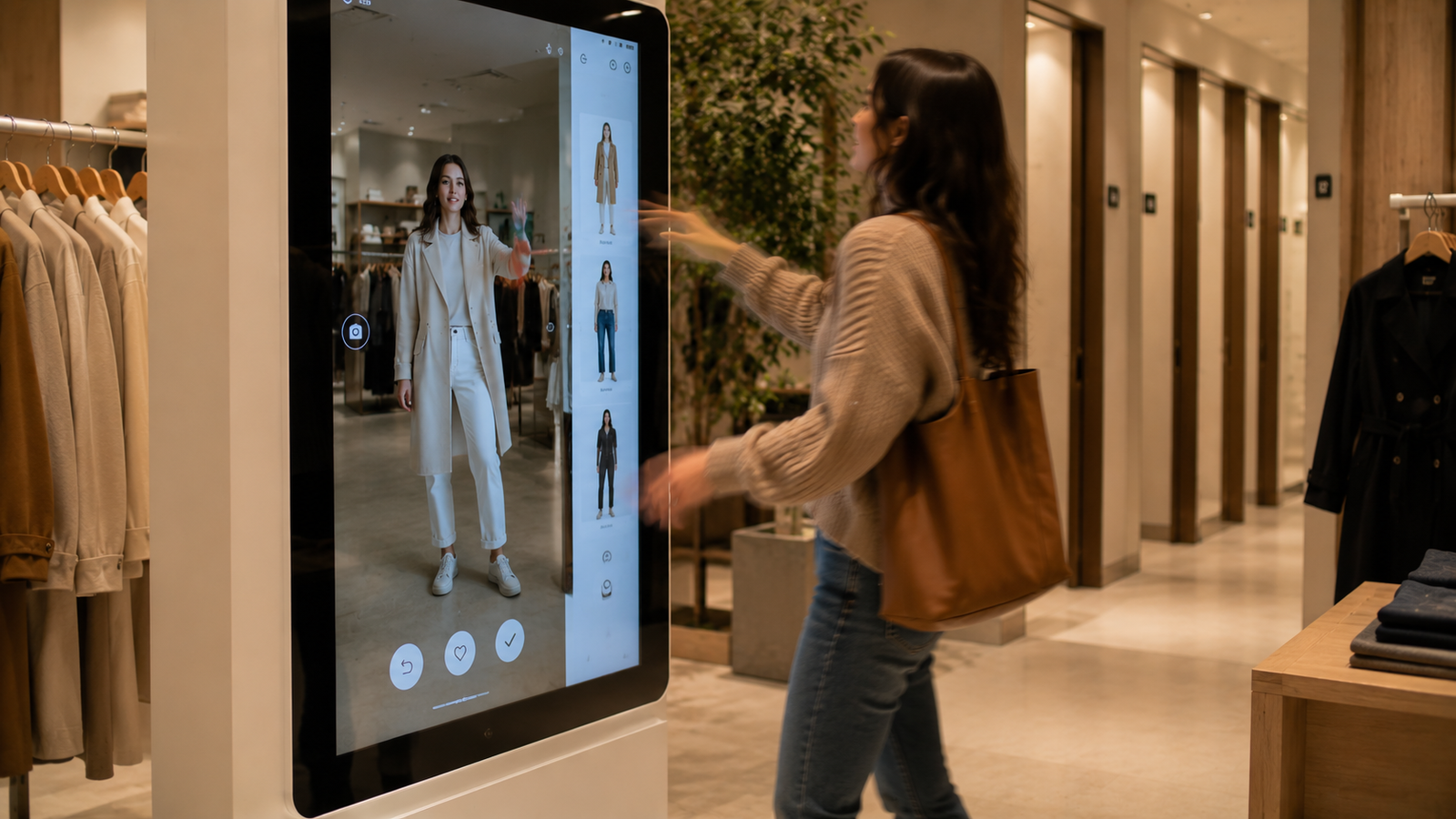
Real-time virtual try-on is built for the store moment: the shopper selects garments and keeps exploring in front of an interactive display. The buyer value is immediacy, continuity, and assisted discovery rather than a delayed photo upload workflow.
Real-time virtual try-on matters because the store interaction is fragile. If the shopper has to stop, upload, wait, and interpret a detached result, the conversation can lose momentum before the retailer learns what the shopper actually likes.
iKawn Mirror is positioned around the live store moment: selected garments, shopper movement, staff support, and a clear path from visual exploration to retail action.
Real-time matters when the shopper is already in motion. The experience has to keep up with the store conversation.
Why real-time behavior matters for store teams
Retail interactions lose momentum when a shopper must pause, upload, wait, and interpret a disconnected result. A real-time Mirror flow keeps the try-on experience inside the conversation between shopper, garment, and associate.
The deployment test should verify the actual device, lighting, camera behavior, garment selection, and reset controls. Real-time positioning should be proven in the environment where it will operate.
What real-time means here
For a retail buyer, real-time means the experience is designed around a live store interaction, not a delayed photo generation flow. Specific latency or frame-rate claims should be validated in a deployment test.
The practical question for a buyer is how this translates into the store journey: what the shopper sees, what staff can support, what content must be prepared, and what decision the retailer wants after the try-on moment.
Key considerations:
- The shopper can continue exploring alternatives in the moment.
- The store team can keep the conversation active.
- The experience fits a kiosk or assisted selling context.
Where photo based VTO still fits
Photo based virtual try-on can be useful for ecommerce, remote browsing, and lower-touch flows. It is not automatically wrong. The choice depends on the buying moment.
The practical question for a buyer is how this translates into the store journey: what the shopper sees, what staff can support, what content must be prepared, and what decision the retailer wants after the try-on moment.
Key considerations:
- Photo based flows can fit asynchronous product page discovery.
- Real-time flows fit store discovery and events better.
- A retailer can use both models for different parts of the journey.
Evaluation checklist
A retail team should test the actual camera, garment selection, color fidelity, shopper movement, and operating flow before treating any real-time system as ready for rollout.
The practical question for a buyer is how this translates into the store journey: what the shopper sees, what staff can support, what content must be prepared, and what decision the retailer wants after the try-on moment.
Key considerations:
- Does the selected garment stay selected?
- Does the garment type, color, and texture remain faithful enough for the use case?
- Can staff restart or stop the experience cleanly?
- Does the page fail clearly when a garment cannot be loaded?
How to evaluate this before a pilot
A strong pilot starts with a narrow use case and a clear store environment. It should prove whether shoppers understand the experience, whether selected garments remain faithful, and whether the retail team can move from visual exploration to a useful next action.
Evaluation checks:
- Test camera start, stop, permission, and reset behavior on the target device.
- Verify that selected garment color, texture, type, and silhouette stay faithful to the approved garment set.
- Confirm the experience behaves clearly when a garment cannot load.
- Measure whether shoppers continue exploring instead of abandoning after the first attempt.
What the pilot has to prove
The pilot should produce operational confidence, not only a visual demo. Retail teams should be able to start, reset, explain, and support the experience during realistic store conditions.
Proof points:
- The front camera or retail camera starts in the expected state for the chosen device.
- The shopper can stop the stream or exit the experience through an obvious control.
- The selected garment does not change into a different garment, color, or texture during the flow.
Where expectations need to stay clear
The page should help a buyer understand where virtual try-on is useful and where normal retail judgment still matters. That clarity improves trust and reduces the risk of overpromising before a deployment is validated.
Boundaries:
- Virtual try-on supports discovery and preselection; it does not replace physical fabric feel.
- Complex drape, shine, transparency, and embellishment need garment-level validation.
- Do not publish conversion, accuracy, or revenue claims without measured deployment data.
Scope this for a real retail environment
Share the market, store format, garment category, launch timeline, and whether this is for a store pilot, mall activation, or campaign. iKawn can then map the right Mirror workflow and demo path.