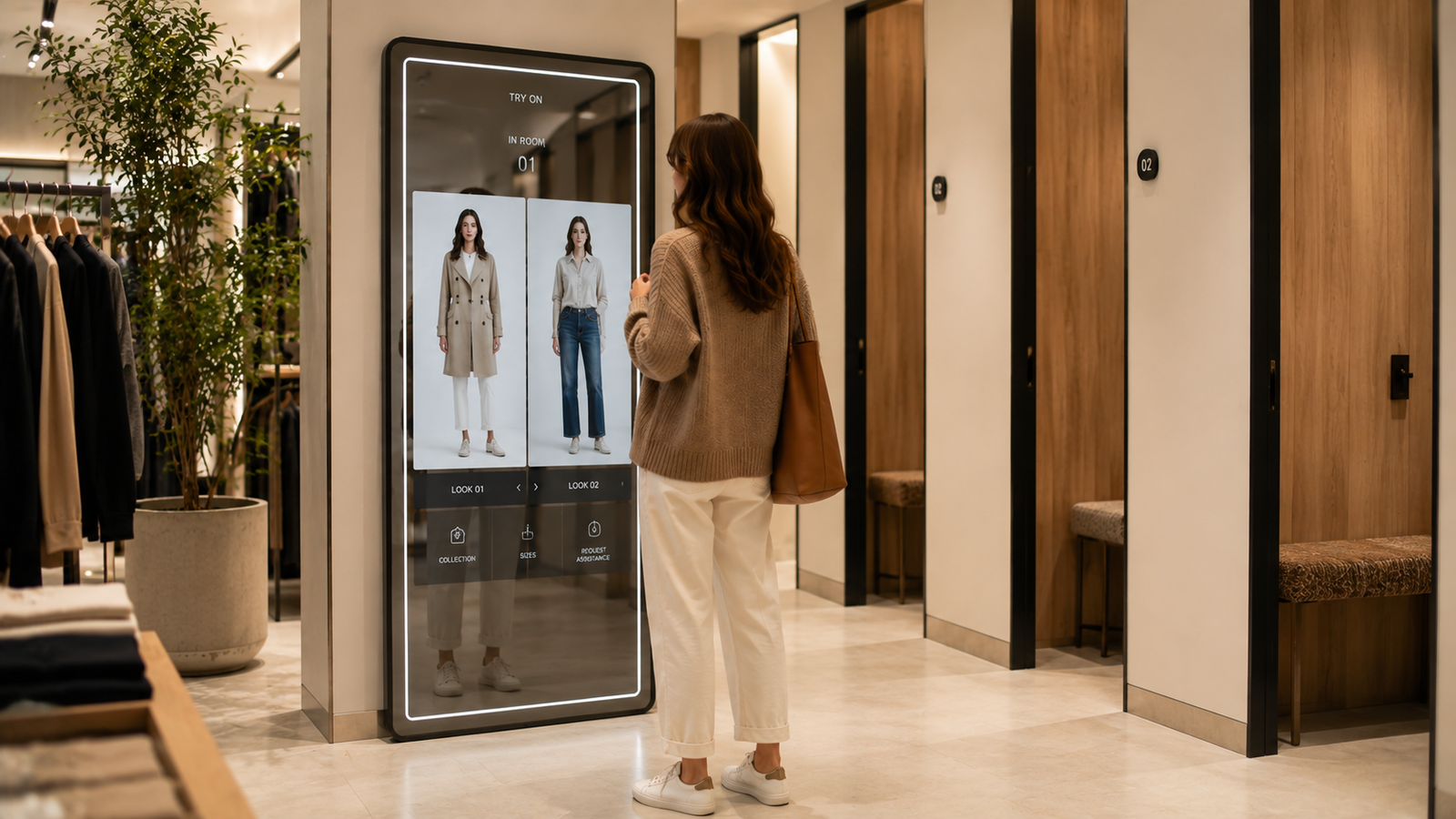
An AI virtual fitting room helps shoppers preview garments before deciding what to try physically or buy. In iKawn Mirror, the role is retail discovery and preselection, not a promise to replace final fit, tailoring judgment, or fabric feel.
A virtual fitting room is strongest when it helps shoppers narrow choices before the physical fitting step. It gives the shopper a faster way to compare options, while keeping final fit, fabric feel, and comfort checks in the normal retail journey.
iKawn Mirror should be evaluated as a discovery layer for physical retail. It can help stores make a larger assortment easier to browse without pretending that visual try-on replaces the certainty of wearing the garment.
Virtual fitting works best before the fitting room, where it helps shoppers build confidence about what is worth trying physically.
Where a virtual fitting room fits in store operations
The best virtual fitting room workflow sits before the traditional fitting room. It helps shoppers compare styles faster, narrow options, and involve the associate earlier in the buying journey.
For store teams, the value comes from reducing browsing friction and expanding visual discovery while keeping honest boundaries around size, comfort, and material behavior.
Definition for retailers
A virtual fitting room helps shoppers preview outfits visually before deciding which items deserve more attention. In physical retail, the value is speed, exploration, and assisted discovery.
The practical question for a buyer is how this translates into the store journey: what the shopper sees, what staff can support, what content must be prepared, and what decision the retailer wants after the try-on moment.
Key considerations:
- Useful before physical fitting, not a complete substitute for it.
- Helps shoppers explore more looks quickly.
- Gives associates a visual way to discuss alternatives.
How it supports store teams
Retail teams can use a virtual fitting room to guide shoppers through a larger catalog and reduce the effort of trying every possible combination physically.
The practical question for a buyer is how this translates into the store journey: what the shopper sees, what staff can support, what content must be prepared, and what decision the retailer wants after the try-on moment.
Key considerations:
- Preselect outfits before entering the fitting room.
- Show colors, cuts, and styled looks when not all SKUs are on the floor.
- Make collection browsing more interactive during store events.
What it does not replace
A virtual fitting room does not give the shopper fabric feel, exact fit certainty, or tailoring-level judgment. It is best used as a discovery and confidence layer before the final buying decision.
The practical question for a buyer is how this translates into the store journey: what the shopper sees, what staff can support, what content must be prepared, and what decision the retailer wants after the try-on moment.
Key considerations:
- Keep physical fitting available for precise fit decisions.
- Be clear that drape and fabric behavior have limits.
- Use the experience to improve browsing, comparison, and assistance.
How to evaluate this before a pilot
A strong pilot starts with a narrow use case and a clear store environment. It should prove whether shoppers understand the experience, whether selected garments remain faithful, and whether the retail team can move from visual exploration to a useful next action.
Evaluation checks:
- Define which categories are for visual shortlist building and which require physical fitting.
- Train associates to position virtual try-on as discovery, not final fit proof.
- Connect the virtual result to stock, size, or staff assistance where the deployment supports it.
- Use shopper feedback to refine garment categories and content refresh cadence.
What the pilot has to prove
The pilot should produce operational confidence, not only a visual demo. Retail teams should be able to start, reset, explain, and support the experience during realistic store conditions.
Proof points:
- Shoppers understand the experience without long explanation.
- Store teams can start, stop, reset, and introduce the flow cleanly.
- The catalog owner can refresh garments without breaking the retail journey.
Where expectations need to stay clear
The page should help a buyer understand where virtual try-on is useful and where normal retail judgment still matters. That clarity improves trust and reduces the risk of overpromising before a deployment is validated.
Boundaries:
- Physical fit, tailoring needs, comfort, fabric weight, and touch still need normal retail judgment.
- Complex garments should be validated before being used in a public claim.
- Do not remove fitting-room workflows for products where final fit confidence is critical.
Scope this for a real retail environment
Share the market, store format, garment category, launch timeline, and whether this is for a store pilot, mall activation, or campaign. iKawn can then map the right Mirror workflow and demo path.