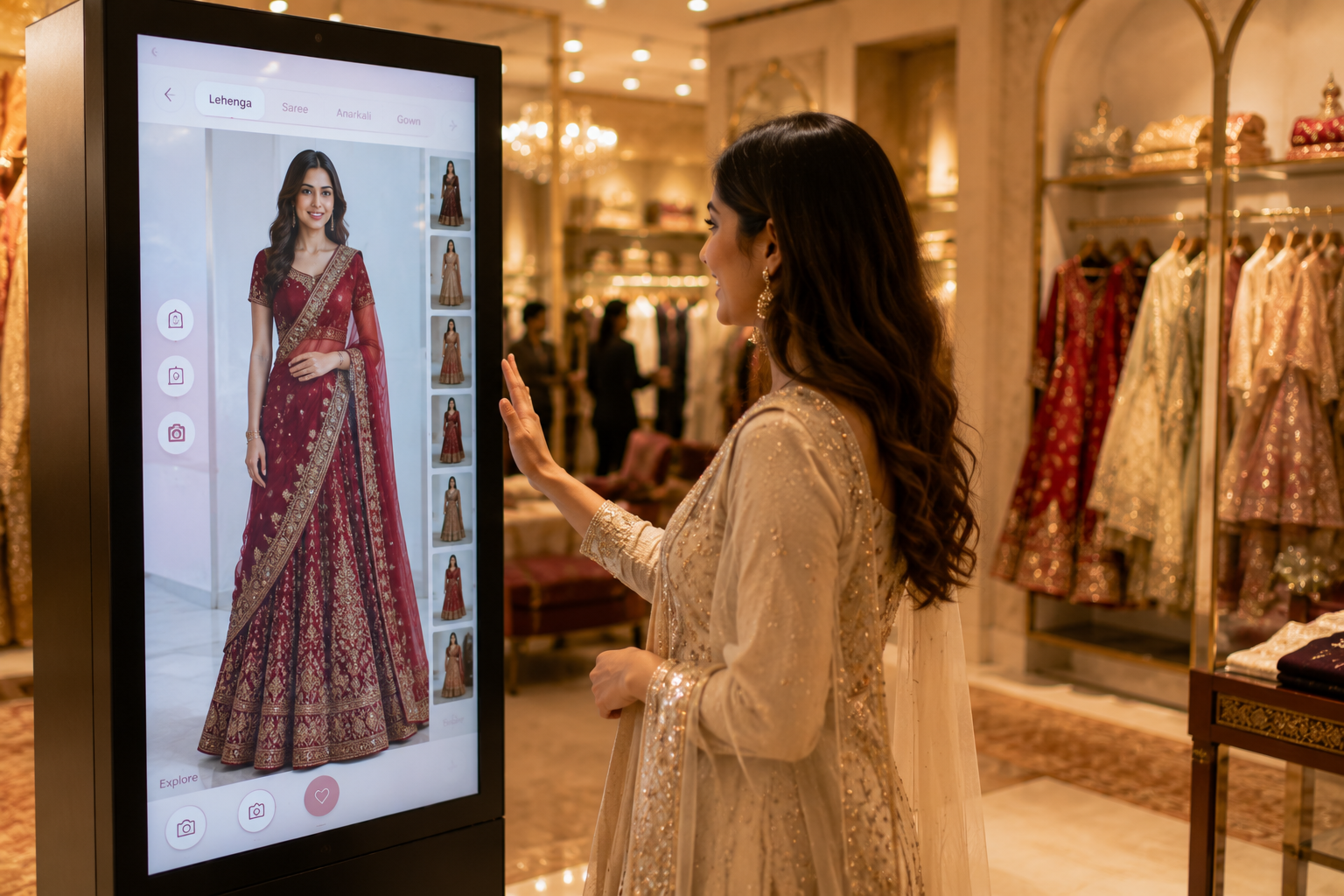
Ethnic wear is a strong iKawn Mirror use case for visual discovery because shoppers often compare color, silhouette, styling, embellishment, and occasion fit before narrowing choices. Retailers should test garment behavior honestly, especially for drape-heavy or highly detailed pieces.
Ethnic wear is one of the most visual retail categories, but also one of the easiest to overstate. Shoppers compare color, silhouette, embellishment, styling, occasion fit, and drape. A virtual try-on experience can support that discovery, but it must be honest about fabric behavior and final fit.
iKawn Mirror is best used here as a shortlist and styling layer. It can help shoppers explore more options before physical trial, especially in wedding, festive, and occasion-led retail journeys.
For ethnic wear, the honest promise is discovery and shortlist building. Drape, detail, and final fit still deserve careful validation.
How to approach ethnic wear virtual try-on
Sarees, lehengas, kurtas, sherwanis, gowns, and occasion wear are visually rich, but they can also be harder than basic garments. Drape, embroidery, transparency, shine, and layered styling should be validated with real product expectations.
Mirror can help shoppers shortlist options during wedding, festive, and occasion-led shopping. The best flow keeps staff guidance and physical trial available for final confidence.
Why ethnic wear is visual
Sarees, lehengas, kurtas, and occasion wear often involve color, styling, drape, and coordination decisions. A virtual try-on experience can help shoppers explore more options before physical trials.
The practical question for a buyer is how this translates into the store journey: what the shopper sees, what staff can support, what content must be prepared, and what decision the retailer wants after the try-on moment.
Key considerations:
- Helpful for high SKU discovery.
- Useful during wedding and festival shopping seasons.
- Supports assisted selling when shoppers compare many looks.
Set honest expectations
Ethnic wear can involve complex drape, fabric behavior, embroidery, transparency, and styling. Retailers should test the actual garments before promising exact fabric or drape reproduction.
The practical question for a buyer is how this translates into the store journey: what the shopper sees, what staff can support, what content must be prepared, and what decision the retailer wants after the try-on moment.
Key considerations:
- Do not claim perfect saree drape without proof.
- Use virtual try-on for discovery and shortlist building.
- Keep staff guidance and physical fitting part of the final journey.
Useful retail scenarios
The strongest use cases are situations where shoppers need to compare many looks quickly while staying inside the store conversation.
The practical question for a buyer is how this translates into the store journey: what the shopper sees, what staff can support, what content must be prepared, and what decision the retailer wants after the try-on moment.
Key considerations:
- Wedding shopping previews.
- Festive collection discovery.
- Occasion wear recommendations.
- Color and styling comparison before physical trial.
How to evaluate this before a pilot
A strong pilot starts with a narrow use case and a clear store environment. It should prove whether shoppers understand the experience, whether selected garments remain faithful, and whether the retail team can move from visual exploration to a useful next action.
Evaluation checks:
- Start with a limited set of garments that represent the desired shopper journey.
- Validate color, texture, embellishment visibility, and garment type before launch.
- Use the experience for discovery and shortlist building rather than exact drape promises.
- Plan staff involvement for styling, sizing, and final physical trial guidance.
What the pilot has to prove
The pilot should produce operational confidence, not only a visual demo. Retail teams should be able to start, reset, explain, and support the experience during realistic store conditions.
Proof points:
- Shoppers compare more colors or styles before asking for physical garments.
- Associates can use the visual shortlist to make better recommendations.
- The experience does not overstate fabric physics, drape, or tailoring accuracy.
Where expectations need to stay clear
The page should help a buyer understand where virtual try-on is useful and where normal retail judgment still matters. That clarity improves trust and reduces the risk of overpromising before a deployment is validated.
Boundaries:
- Virtual try-on supports discovery and preselection; it does not replace physical fabric feel.
- Complex drape, shine, transparency, and embellishment need garment-level validation.
- Do not publish conversion, accuracy, or revenue claims without measured deployment data.
Scope this for a real retail environment
Share the market, store format, garment category, launch timeline, and whether this is for a store pilot, mall activation, or campaign. iKawn can then map the right Mirror workflow and demo path.