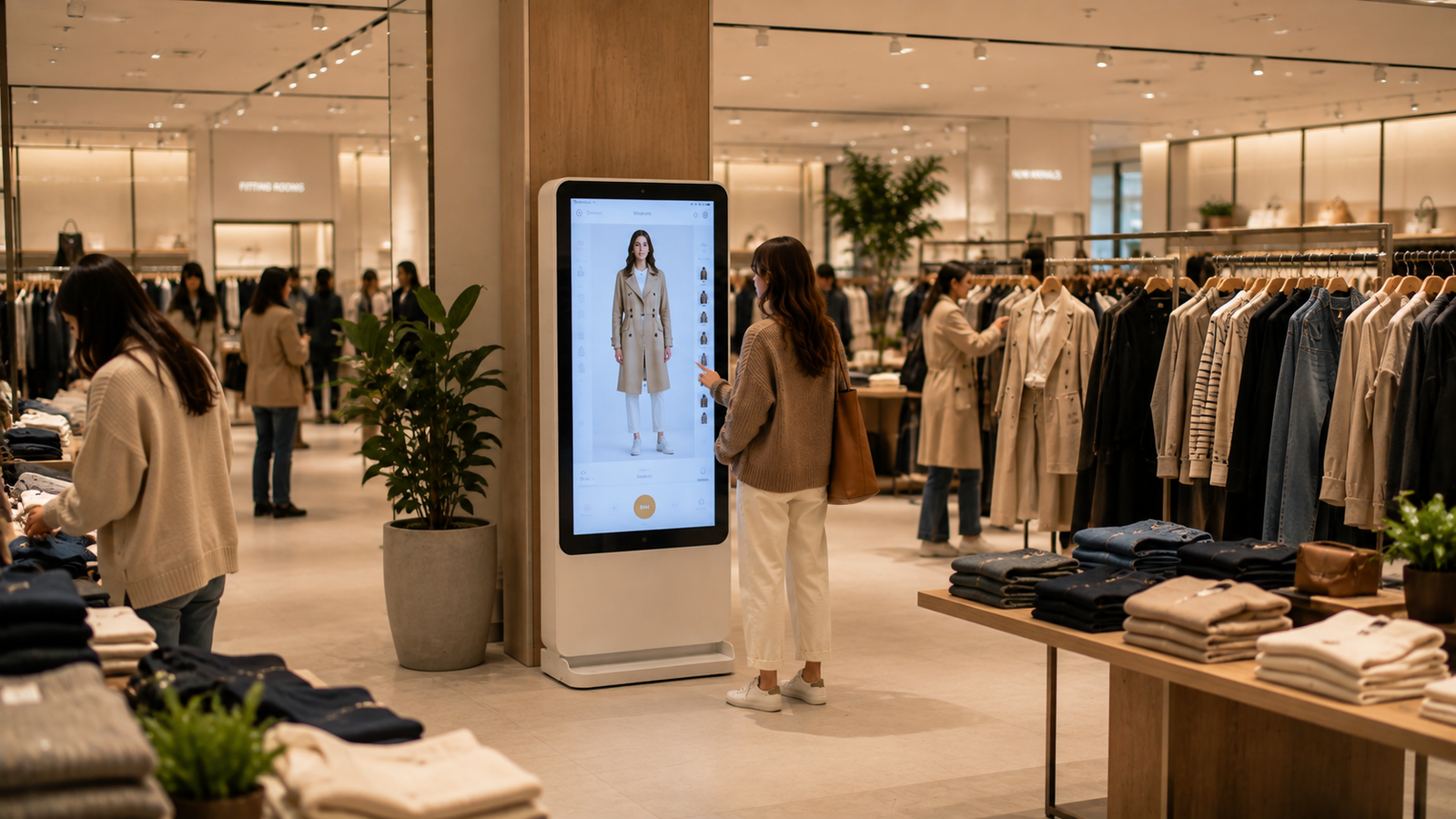
For fashion retailers, iKawn Mirror is a store-first virtual try-on layer for collection discovery, endless aisle browsing, assisted selling, and campaign moments. It is useful when a retailer wants shoppers to explore more garments without turning the journey into a generic photo app.
Fashion retail does not usually lose shoppers because the store lacks products. It loses them when browsing becomes work. A shopper may like a category, a fabric, or a color family, but still walk away because seeing enough options requires too many garment pulls, too much changing, or too much staff time.
iKawn Mirror is useful in that gap. It gives the store a visual discovery layer where shoppers can explore more styles before deciding what deserves physical trial or associate attention. For a fashion retailer, the business question is simple: can the store turn existing footfall into more meaningful product exploration without making the shopper feel slowed down?
This page looks at iKawn Mirror from the retailer side: store engagement, endless aisle discovery, staff-assisted selling, campaign launches, and the practical checks needed before a pilot.
The strongest fashion retail use case is not novelty. It is helping shoppers see more of the assortment before the store asks them to commit time, attention, or fitting-room effort.
The store problem is attention without exploration
A fashion store can be busy and still underexplored. Shoppers may walk past racks, notice only the front-facing merchandise, and avoid asking for more options because each request adds effort. This is especially visible in stores with high SKU depth, fast-moving collections, or products where color and styling matter as much as size.
The fitting room is valuable, but it is also a bottleneck. Shoppers do not want to physically try every jacket, kurta, dress, or occasion look just to decide whether the silhouette is interesting. Store teams need a layer before physical fitting where curiosity can turn into a shortlist.
What iKawn Mirror changes for the shopper
iKawn Mirror gives the shopper a visual way to explore garments while staying in the retail environment. The shopper can move from one style to another, compare color directions, and decide which products deserve staff help or physical trial.
The experience should feel like part of the store. It should not ask the shopper to become a content creator, upload a photo, or leave the retail moment. A good Mirror flow keeps attention on the assortment and makes the next action obvious.
A useful shopper session should make it easy to:
- browse a focused collection without feeling overwhelmed
- try more than one style family before asking for garments
- compare colors, silhouettes, and campaign looks quickly
- move from virtual discovery to associate help or product selection
How this supports fashion retailers
For retailers, Mirror is strongest when it connects to existing commercial goals: new collection launches, endless aisle discovery, assisted selling, store events, and higher-quality product conversations. It should make the store easier to browse, not add a disconnected attraction.
An endless aisle use case is especially relevant when a store cannot show every variant on the floor. Mirror can help staff discuss broader assortment possibilities, curated looks, and campaign-specific product sets while the shopper is still engaged.
The business use cases to evaluate first are:
- new collection and campaign discovery
- high SKU category exploration
- assisted selling for shoppers who need styling guidance
- mall or flagship experiences that need a visible interaction point
What needs to be true before a rollout
A retailer should not start with the question, "which screen do we buy?" The better starting point is the retail journey: who uses the experience, which garments are available, who updates the catalog, and what happens when the shopper finds a look they like.
Garment selection fidelity is a core acceptance criterion. If a shopper selects a peach jacket, the experience should not drift into an unrelated grey jacket or a different garment type. The selected clothing type, color direction, texture, and visible style cues need to stay consistent enough for the approved retail use case.
Before launch, test:
- Choose a focused category or collection before expanding the catalog.
- Make garment selection explicit so a peach jacket, kurta, saree, or dress remains the selected item throughout the flow.
- Prepare staff scripts for introducing the experience without overselling fit certainty.
- Track useful engagement such as qualified interactions, product interest, and assisted follow-up.
What not to overclaim
Virtual try-on can help discovery, shortlist building, and assisted selling. It does not replace fabric touch, tailoring judgment, exact size confidence, or the shopper's final comfort decision.
The right promise is practical: help the shopper explore more of the assortment and help the retailer guide the next step. Accuracy, revenue, and conversion claims should be made only when they come from measured deployment data.
Keep these boundaries visible:
- Virtual try-on supports discovery and preselection; it does not replace physical fabric feel.
- Complex drape, shine, transparency, and embellishment need garment-level validation.
- Do not publish conversion, accuracy, or revenue claims without measured deployment data.
Scope this for a real retail environment
Share the market, store format, garment category, launch timeline, and whether this is for a store pilot, mall activation, or campaign. iKawn can then map the right Mirror workflow and demo path.