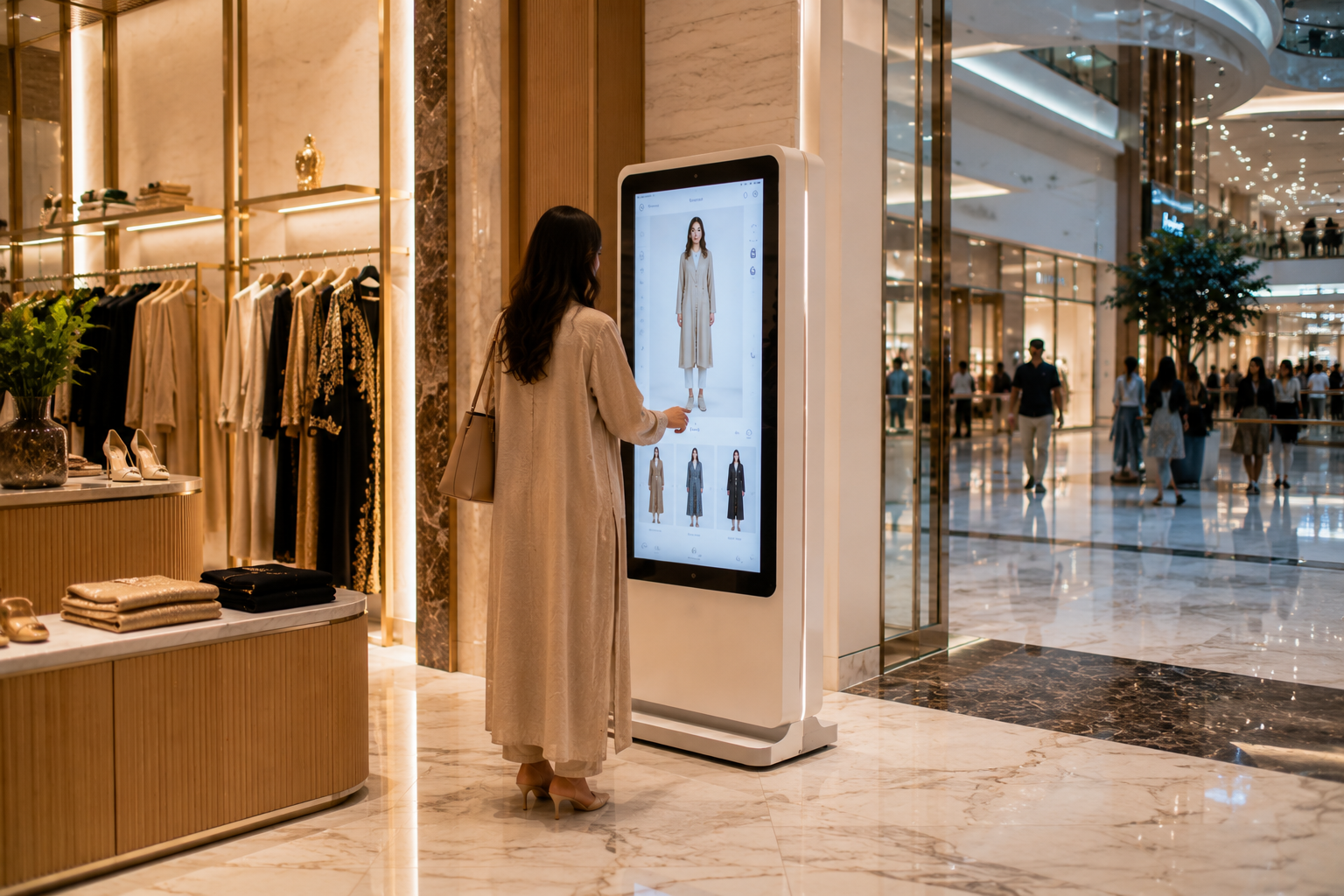
In the UAE, iKawn Mirror is suited to premium malls, flagship fashion retail, tourist-heavy stores, pop-ups, and brand activations where the try-on experience must feel polished and operationally clear. Deployment should be scoped around venue, campaign duration, and garment content.
UAE retail often combines premium malls, tourists, flagship stores, pop-ups, and brand-led events. In that environment, virtual try-on has to feel polished, guided, and commercially useful, not like a novelty station.
iKawn Mirror can be evaluated for Dubai and wider UAE fashion settings where the retail team wants an interactive product discovery moment tied to a real venue, campaign, or store workflow.
In the UAE, iKawn Mirror is suited to premium malls, flagship fashion retail, tourist-heavy stores, pop-ups, and brand activations where the try-on experience must feel polished and operationally clear. Deployment should be scoped around venue, campaign duration, and garment content.
UAE retail context for Mirror
UAE retail often blends premium store environments, mall-led discovery, events, tourists, and brand-led experiences. A Mirror deployment should be designed for that setting instead of copying a remote ecommerce flow.
The useful buyer questions are practical: who owns the venue setup, which garments are used, how staff guide shoppers, and what happens after the shopper finds a look.
UAE retail context
UAE retail often blends mall-led discovery, premium stores, tourist footfall, events, and brand-led experiences. A virtual try-on plan should be designed for that environment rather than copied from a generic ecommerce workflow.
The practical question for a buyer is how this translates into the store journey: what the shopper sees, what staff can support, what content must be prepared, and what decision the retailer wants after the try-on moment.
Key considerations:
- Strong fit for premium retail and mall activations.
- Useful when a brand wants a clear attraction inside a campaign zone.
- Relevant to flagship locations where experience quality matters.
Dubai and wider UAE planning
A deployment conversation should cover venue, campaign duration, garment content, staff involvement, shopper handoff, and hardware responsibilities.
The practical question for a buyer is how this translates into the store journey: what the shopper sees, what staff can support, what content must be prepared, and what decision the retailer wants after the try-on moment.
Key considerations:
- Temporary event kiosk or permanent store experience.
- Single brand or multi-brand assortment.
- Retail associate-led or shopper-led flow.
What not to assume
This page does not claim existing UAE mall deployments, customer names, or venue partnerships. Those claims should be added only when approved and verifiable.
The practical question for a buyer is how this translates into the store journey: what the shopper sees, what staff can support, what content must be prepared, and what decision the retailer wants after the try-on moment.
Key considerations:
- No fabricated mall names.
- No invented campaign results.
- No unapproved customer logos or locations.
How to evaluate this before a pilot
A strong pilot starts with a narrow use case and a clear store environment. It should prove whether shoppers understand the experience, whether selected garments remain faithful, and whether the retail team can move from visual exploration to a useful next action.
Evaluation checks:
- Confirm whether the deployment is for Dubai, wider UAE, a mall campaign, or a permanent store experience.
- Scope bilingual or staff-assisted flows if the retail environment needs them.
- Prepare venue, schedule, garment rights, hardware responsibility, and support expectations.
- Avoid unapproved customer, mall, or campaign claims until they are verified and permitted for public use.
What the pilot has to prove
The pilot should produce operational confidence, not only a visual demo. Retail teams should be able to start, reset, explain, and support the experience during realistic store conditions.
Proof points:
- Shoppers understand the experience without long explanation.
- Store teams can start, stop, reset, and introduce the flow cleanly.
- The catalog owner can refresh garments without breaking the retail journey.
Where expectations need to stay clear
The page should help a buyer understand where virtual try-on is useful and where normal retail judgment still matters. That clarity improves trust and reduces the risk of overpromising before a deployment is validated.
Boundaries:
- Virtual try-on supports discovery and preselection; it does not replace physical fabric feel.
- Complex drape, shine, transparency, and embellishment need garment-level validation.
- Do not publish conversion, accuracy, or revenue claims without measured deployment data.
Scope this for a real retail environment
Share the market, store format, garment category, launch timeline, and whether this is for a store pilot, mall activation, or campaign. iKawn can then map the right Mirror workflow and demo path.