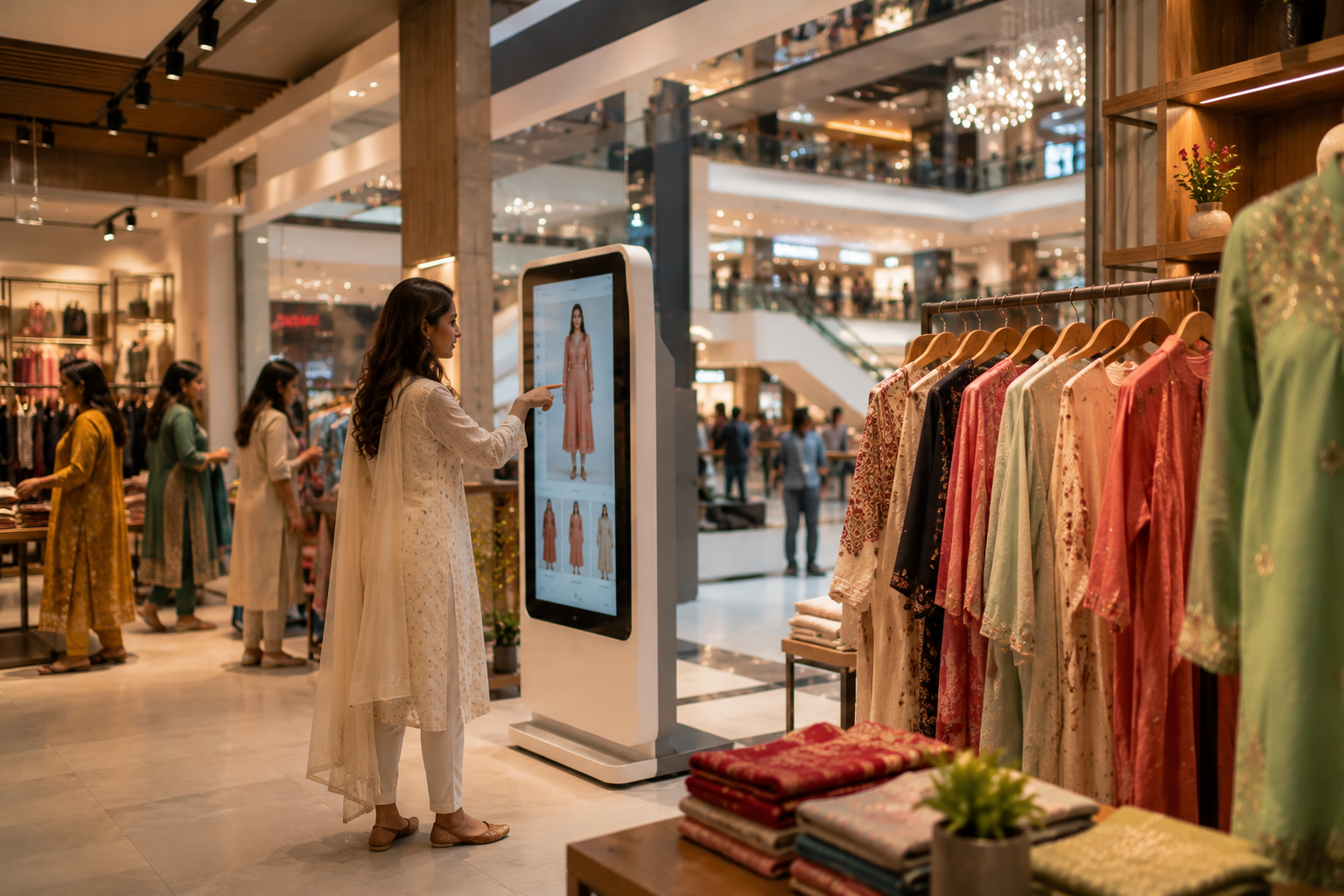
In India, iKawn Mirror is positioned for fashion chains, mall stores, ethnic wear retailers, exhibitions, and multi-city retail teams that need a practical in-store virtual try-on workflow. The first phase should be scoped around local store formats and garment categories.
India is not one fashion-retail use case. Mall stores, high street outlets, wedding retail, ethnic wear, western wear, exhibitions, and multi-city chains all create different expectations for try-on, staff assistance, and catalog depth.
For India, iKawn Mirror should be planned around specific store formats and garment categories. A good first pilot is narrow enough to test honestly, but useful enough to show whether shoppers explore more products in the store.
In India, iKawn Mirror is positioned for fashion chains, mall stores, ethnic wear retailers, exhibitions, and multi-city retail teams that need a practical in-store virtual try-on workflow. The first phase should be scoped around local store formats and garment categories.
India-specific planning for Mirror
Indian fashion retail has wide variation across mall stores, high street stores, exhibitions, wedding retail, ethnic wear, western wear, and multi-brand assortments. A Mirror plan should not treat these contexts as one generic market.
For India, the strongest content and deployment questions are around store placement, language and staff support where needed, high SKU discovery, seasonality, and honest expectations for drape-heavy garments.
Why India needs a local retail lens
Indian fashion retail spans mall stores, high street stores, occasion wear, ethnic wear, western wear, and high SKU assortments. A virtual try-on plan should respect those buying contexts.
The practical question for a buyer is how this translates into the store journey: what the shopper sees, what staff can support, what content must be prepared, and what decision the retailer wants after the try-on moment.
Key considerations:
- Useful for stores where shoppers compare many styles.
- Relevant to launches, exhibitions, mall activations, and flagship experiences.
- Particularly interesting for occasion and ethnic wear discovery when expectations are set clearly.
India deployment questions
Before quoting or rollout, teams should define location type, catalog scope, staff role, language needs, campaign context, and whether the kiosk is temporary or permanent.
The practical question for a buyer is how this translates into the store journey: what the shopper sees, what staff can support, what content must be prepared, and what decision the retailer wants after the try-on moment.
Key considerations:
- Which stores or mall zones should launch first?
- Which garment categories are realistic for phase one?
- What action should the shopper take after the try-on experience?
Pricing in India
India pricing should start from the published Mirror pricing table, then be scoped by kiosk configuration, screen size, hardware ownership, catalog work, installation, support, and whether the deployment is purchased, monthly rental, or event rental.
The practical question for a buyer is how this translates into the store journey: what the shopper sees, what staff can support, what content must be prepared, and what decision the retailer wants after the try-on moment.
Key considerations:
- Use the pricing guide to choose the starting commercial model.
- Confirm the screen size, utility, venue, and expected usage minutes.
- Book a deployment discussion for India-specific installation and support planning.
How to evaluate this before a pilot
A strong pilot starts with a narrow use case and a clear store environment. It should prove whether shoppers understand the experience, whether selected garments remain faithful, and whether the retail team can move from visual exploration to a useful next action.
Evaluation checks:
- Pick launch cities, store formats, and garment categories before asking for a quote.
- Decide whether the use case is permanent store experience, seasonal campaign, exhibition, or mall activation.
- Prepare catalog assets for ethnic wear and occasion wear with realistic validation of drape and detail.
- Define consent and data handling if any lead capture or digital handoff is scoped.
What the pilot has to prove
The pilot should produce operational confidence, not only a visual demo. Retail teams should be able to start, reset, explain, and support the experience during realistic store conditions.
Proof points:
- Shoppers understand the experience without long explanation.
- Store teams can start, stop, reset, and introduce the flow cleanly.
- The catalog owner can refresh garments without breaking the retail journey.
Where expectations need to stay clear
The page should help a buyer understand where virtual try-on is useful and where normal retail judgment still matters. That clarity improves trust and reduces the risk of overpromising before a deployment is validated.
Boundaries:
- Virtual try-on supports discovery and preselection; it does not replace physical fabric feel.
- Complex drape, shine, transparency, and embellishment need garment-level validation.
- Do not publish conversion, accuracy, or revenue claims without measured deployment data.
Scope this for a real retail environment
Share the market, store format, garment category, launch timeline, and whether this is for a store pilot, mall activation, or campaign. iKawn can then map the right Mirror workflow and demo path.