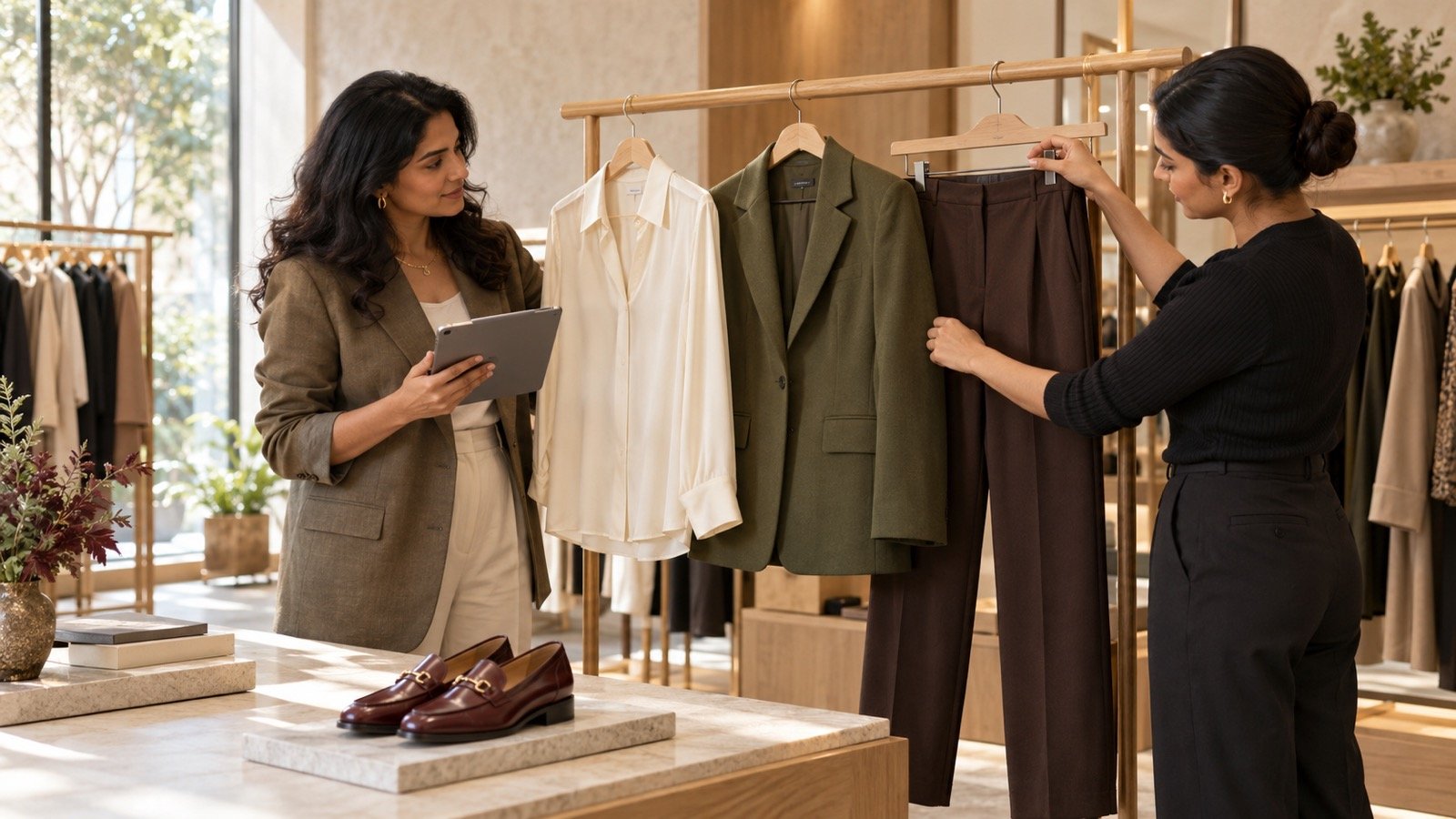
A shopper has chosen a jacket. Your merchandising team knows which trousers complement it, but a product tile does not answer the shopper’s question: “Would I wear them together?” That is a specific opportunity to evaluate virtual try-on. It is also easy to mistake another interaction for another sale.
Virtual try-on for outfit cross-selling deserves a pilot when visual uncertainty is stopping a relevant second purchase, and the additional contribution could cover the cost of the experience. For fashion merchandising directors, ecommerce leaders and founders, the buying decision is whether a preview adds value beyond the outfit recommendations you already offer. This guide proposes how to test that question with iKawn Mirror; it does not claim an established increase in basket size.
Why this belongs in a merchandising budget discussion
The BoF–McKinsey State of Fashion 2026, published November 17, 2025, describes value-conscious consumers and forecasts low single-digit fashion industry growth in 2026. That is a dated forecast, not a confirmed full-year result. Our interpretation: a cross-selling proposal needs to make the additional purchase useful to the shopper and economically worthwhile to the retailer.
Investment appetite alone is insufficient evidence. In its June 2, 2026 report announcement, DHL said 73% of surveyed ecommerce businesses anticipated greater use of generative AI over the following five years. The study covered 5,800 businesses and 29,000 shoppers across 29 countries. This is a broad ecommerce investment signal, not a fashion try-on adoption rate or a cross-selling benchmark.
A useful budget trigger is a planned refresh of your complete-the-look experience, an assisted-selling review, or a collection with complementary products that customers struggle to visualise. Before buying technology, inspect your own shopper questions, outfit recommendation clicks, stock availability and second-item purchases. If the real obstacle is price or an unavailable size, a preview has a weaker case.
Separate outfit discovery from outfit rendering
Google’s October 9, 2025 Australian try-on announcement described photo-based previews of tops, bottoms, dresses and shoes, with saved looks and a handoff to the merchant. It explicitly positioned shoes as helping shoppers coordinate an outfit. This is a public platform example of the shopping direction, not evidence of incremental revenue, simultaneous multi-garment rendering or an iKawn deployment.
Keep three capabilities separate in your brief: selecting complementary products, previewing each product on a shopper, and rendering several selected products together while preserving their details. Do not assume that a supplier offering the second capability also provides the first or third.
A sequential journey may still be useful: preview the jacket, inspect a recommended trouser separately, then return to both product records. But it cannot prove how the exact jacket and trousers look together. If combined appearance is essential to your hypothesis, require that exact combination in the demonstration. The Mirror workflow guide provides context for a discussion of the supported experience.
Write an outfit brief that a buyer can accept
Use one anchor category and a small set of editorially approved complements. The following are proposed acceptance questions, not statements that these capabilities are included in every Mirror deployment.
- Merchandising truth: who approves each pairing and its intended occasion? A visually attractive generated combination must still map to real, separately identifiable products.
- Preview truth: does changing the second garment preserve the first garment’s colour, length, print and defining details? If only separate previews are supported, is that limitation clear to the shopper?
- Purchase truth: can the customer find the exact variants, see individual prices and remove the extra item? Confirm whether product handoff and cart behaviour require integration.
- Availability: who removes a recommendation when a size or colour sells out? Test what the shopper sees when only part of the look remains available.
- Service: in a store, can an associate retrieve the selected pieces without repeating the consultation? Online, can a shopper decline try-on and continue with ordinary product information?
For example, a hypothetical workwear pilot could pair a jacket with one approved trouser and one alternative. Exclude shoes unless their preview is supported and commercially relevant. This keeps the test focused on a second-item decision rather than introducing an entire wardrobe experience.
Measure what the preview adds to your existing recommendations
Where practical, randomly assign eligible shoppers to the current complete-the-look journey or the same products and offers with access to a preview. Keeping the recommendations comparable helps distinguish the contribution of visualisation from the contribution of better styling. Retain shoppers in their assigned group even if they decline to use try-on; comparing enthusiastic users with all non-users would mix selection effects with the feature’s effect.
Agree the eligibility rule before launch, such as visitors to a selected jacket range. Track successful previews and product handoffs to diagnose the journey. For the commercial decision, use these measures together:
- Complement purchase rate: eligible assigned shoppers who buy a designated complementary item, divided by all eligible assigned shoppers.
- Order attachment rate: orders containing an anchor and its designated complement, divided by anchor-containing orders. Report the numerator and denominator; this is conditional on an anchor purchase.
- Anchor conversion: whether the additional step disrupts the original purchase.
- Retained contribution per eligible shopper: revenue kept after refunds, less product cost and agreed variable costs such as fulfilment and return handling, divided by eligible assigned shoppers.
Average order value is a diagnostic measure, not the decision by itself. Larger orders among fewer purchasers can coexist with lower contribution overall. Define the purchase window, use comparable returns follow-up, and ask the analyst to size the test around the smallest improvement worth funding. A short, low-volume pilot may establish usability while leaving sales impact unresolved.
Check whether the extra margin can pay for the experience
The following is illustrative arithmetic, not a benchmark, forecast or iKawn quote. Suppose a programme reaches 10,000 eligible shoppers in a month. An assumed incremental retained complement-purchase rate of one percentage point would mean 100 additional retained purchases. At ₹500 contribution per additional purchase, that creates ₹50,000 before programme costs. With ₹60,000 of monthly programme cost, the scenario is ₹10,000 short of break-even.
On those assumptions, break-even requires 120 additional retained purchases, equivalent to 1.2 percentage points of eligible shoppers. This simplified calculation assumes anchor-product contribution is unchanged and the ₹500 already accounts for relevant variable costs. The actual decision should use the whole-basket contribution comparison, so lost anchor sales, discounts, substitutions and returns are not missed.
Include software and usage charges, integration, outfit curation, catalogue maintenance, measurement and any extra associate time in the cost plan. Have finance define how one-off implementation costs are allocated. Do not assume an existing recommendation engine, automatic outfit curation or a multi-item cart connector is bundled with the preview.
Where iKawn Mirror fits—and when to stop
Evaluate iKawn Mirror for visual fashion discovery and preselection. Bring an anchor garment, its proposed complements, the intended channel and the next purchase action to the demonstration. Ask which categories and combinations can be shown faithfully, how products remain identifiable, and what data and integration work are needed. A convincing visual preview does not establish physical fit, fabric feel or automated size advice.
Stop or revise the cross-selling test if previews alter product details, unavailable items dominate recommendations, the original purchase becomes harder, or the plausible contribution cannot cover the cost. If usage is encouraging but commercial evidence is inconclusive, limit any extension to a named question and spending cap. Use the virtual try-on vendor evaluation checklist to put the agreed scope and acceptance evidence in writing.
A useful live demo should let your merchandising and ecommerce teams decide whether the second-item preview answers a real shopper question. Bring your current attachment rate, eligible traffic and contribution assumptions so the next step can be a focused pilot brief.