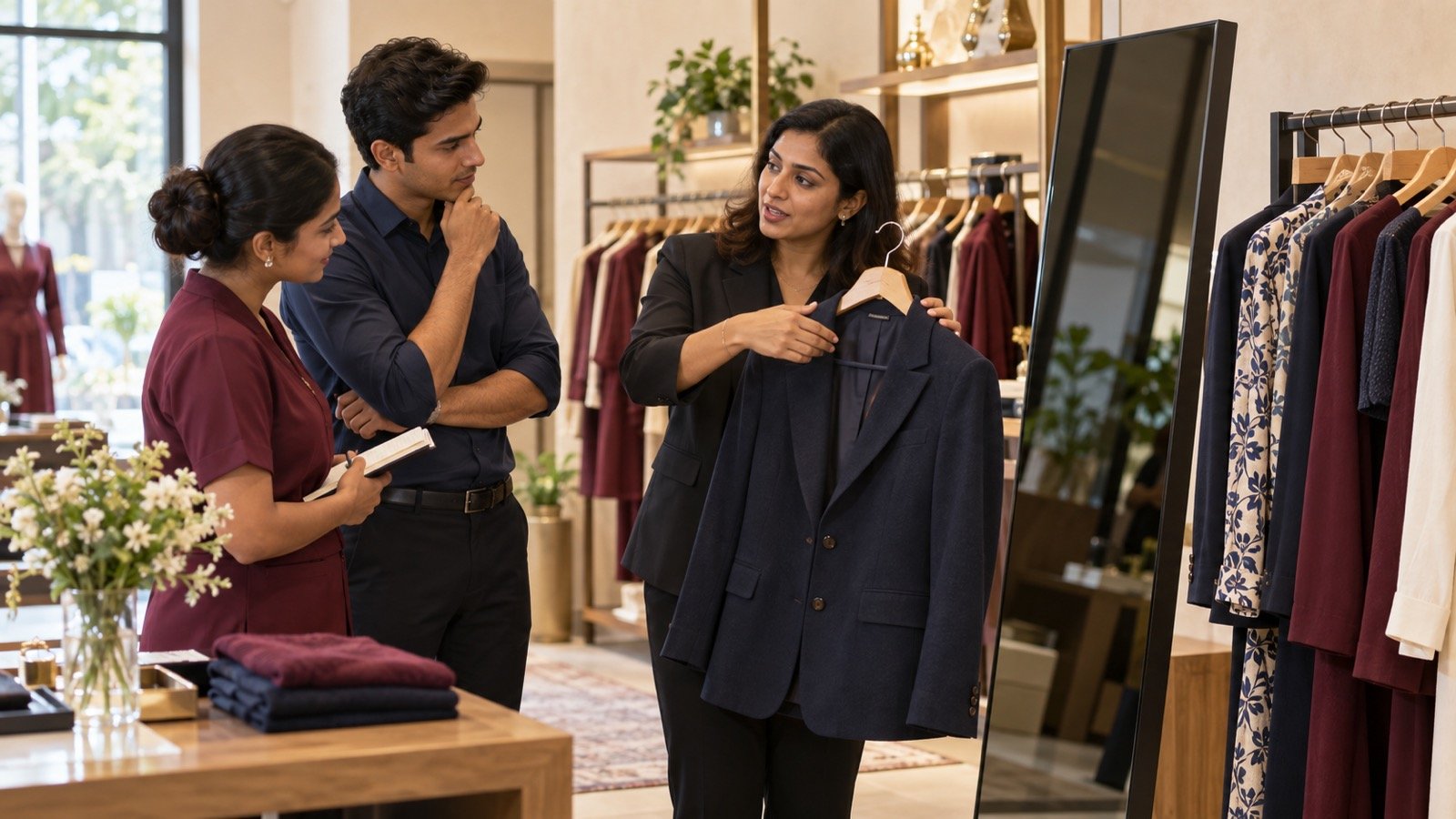
A virtual try-on pilot is ready for the shop floor when ordinary shifts can run it. Before expanding iKawn Mirror across stores, test whether associates can introduce the experience, help a shopper choose a garment, recover from an interruption, and hand a shortlist over to physical fitting or a purchase conversation.
Consider a Saturday afternoon: a shopper likes a jacket on the display, the associate who knows the system is serving someone else, and the selected colour is not on the nearest rail. A convincing demo has not yet solved this service problem. The buying decision is whether the store can support the whole journey within its available staff time.
This guide is for retail operations, CX, omnichannel and innovation leaders deciding how to staff a store-based virtual try-on pilot. The operating framework below is a recommendation, not a report of measured iKawn customer results.
Why staff adoption belongs in the business case
Frontline capacity is a real buying constraint. In its 18th Annual Global Shopper Study, published November 11, 2025, Zebra reported that 88% of surveyed associates struggled to obtain timely assistance or information, while 90% believed the right technology helped them complete tasks faster. MAVRIX conducted the vendor-commissioned online study in May and June 2025 with more than 4,200 shoppers, associates and decision-makers across four regions. These are broad retail perceptions, not fashion-only findings or virtual try-on productivity results.
The budget context also matters. The Business of Fashion–McKinsey State of Fashion 2026, published November 17, 2025, projected low single-digit global fashion growth for 2026. That is a forecast, not an observed full-year result. Our implication for a Mirror buyer: protect selling time and require a clear operational reason for an additional in-store experience.
A new collection, a store refit or a service-improvement programme can create a sensible evaluation window. Tie the pilot to one existing objective, such as helping associates shortlist occasionwear. Budget for training, cover during practice, catalogue maintenance and support alongside the quoted technology costs. If nobody owns these hours, the pilot is under-scoped.
Choose the service model before choosing the launch date
Decide how shoppers should enter the experience. These are staffing options to test, not a claim that every configuration is already available in every Mirror deployment.
- Associate-led: a colleague introduces Mirror and stays through selection. Use this when styling advice is central. Measure the added service time as well as the usefulness of the shortlist.
- Assisted start: an associate explains the experience, then returns when the shopper needs a garment or fitting room. Test whether shoppers can continue without repeated rescue.
- Self-directed with support nearby: consider this only after shoppers can start, exit and find help in the proposed setup. Confirm accessibility and an equivalent assisted route for anyone who cannot or does not want to use it.
Do not start by promising labour savings. If the first model requires a dedicated host, cost that role explicitly. If the business case assumes existing colleagues can absorb the work, test that assumption during the busiest relevant trading periods.
Give every part of the journey an owner
A store manager should be accountable for daily readiness, but should not have to troubleshoot every catalogue or technical issue personally. Assign an owner and a backup for each responsibility before customer use.
- Opening and shift handover — store manager: check the experience, the approved garment selection, the support contact and who covers breaks.
- Shopper introduction — floor associate: explain visual exploration, offer a choice to participate and make the next step clear.
- Garment handoff — selling team: confirm the selected style and variant, check availability in the store's normal system, and arrange a physical fitting or explain an available ordering route.
- Collection changes — merchandising owner: approve the pilot assortment and remove unavailable or unsuitable items from the experience through the agreed workflow.
- Failures and recovery — named support owner: define when staff should retry, stop the experience or return to ordinary assisted selling.
A visual preview is not an inventory reservation. If an endless-aisle order is part of the intended journey, demonstrate the actual ordering handoff during evaluation. Do not assume Mirror includes stock synchronization, checkout or CRM integration without confirming that scope.
Rehearse the awkward moments, not only the ideal session
Use the intended store location, lighting and garments for practice. Ask a colleague who missed the vendor demonstration to run the flow from the staff guide. That reveals what the operation depends on remembering.
- Explain the promise: help the shopper explore how a style looks, while keeping fabric feel, comfort and physical fitting separate. Staff should not describe the preview as a guaranteed size recommendation.
- Handle a hesitant shopper: explain the approved camera and data practices accurately, offer ordinary service if they decline, and avoid improvising privacy assurances.
- Handle a wrong-looking garment: stop using that result to guide a purchase, return to the real product and report the affected SKU for review.
- Handle an interruption: practise a failed load, an associate being called away and a queue forming. Agree a short recovery limit and a useful fallback.
- Finish the session: identify the chosen item and next action, then demonstrate the actual session-clear or reset procedure before the next shopper starts.
Verify capture, retention, deletion, consent and any sharing behavior for the proposed deployment before writing the staff explanation. These are procurement and operating checks; this guide does not claim a particular data-retention policy or certification for iKawn Mirror.
Public retailer examples can help explain the category without substituting for these checks. Walmart announced Be Your Own Model on September 15, 2022, describing an online apparel experience using a shopper's own photo. That historical announcement illustrates a different customer workflow. It does not establish current availability, an in-store staffing benchmark, or results a Mirror buyer should expect.
Measure adoption without rewarding empty activity
Set thresholds with the store team before the pilot. There is no universal target for staffing minutes or adoption that this article can credibly supply. Record enough context to tell a service failure from a quiet trading period.
- Coverage: which planned shifts had a trained owner and backup available? A signed training sheet is not evidence that the experience ran independently.
- Introduction and completion: count suitable invitations, accepted starts and completed sessions separately. Record why shoppers or staff stopped.
- Useful handoff: count sessions that led to a specific garment request, physical fitting or supported order enquiry. Define one counting rule to avoid double-counting a shopper.
- Staff burden: sample active assistance minutes, recovery minutes and interruptions to other service. Include opening checks and catalogue maintenance.
- Commercial follow-through: where consent and existing systems permit, examine purchases, cancellations and returns. Engagement alone is not incremental profit.
For a conversion claim, comparing Mirror volunteers with all other shoppers is weak evidence: those groups may already differ in purchase intent. Agree a suitable comparison with the retailer's analytics team, account for promotions, footfall and staffing changes, and allow returns to mature. Use the Mirror business-case guide to organize costs and assumptions, keeping unmeasured benefits explicitly provisional.
Answer the objections before expanding
“We do not have another person to spare.” Trial a limited service window or an assisted-start model only if the proposed workflow supports it. If the measured burden exceeds the available coverage, reduce scope or defer expansion. An unfunded hosting role is not a rollout plan.
“Staff will only use it when the manager is watching.” Observe independent shifts and ask what made it harder to sell. Simplify the introduction or handoff where needed. Avoid targets based only on session volume, which can reward demonstrations with no useful product conversation.
“A successful flagship pilot should work everywhere.” Require a second context with different footfall, space or staffing before making that assumption. Choose a go, revise or stop decision based on repeatable service, acceptable workload and an intact shopper promise.
Where iKawn Mirror fits
iKawn Mirror is positioned around live visual try-on and fashion discovery. For a store buyer, the evaluation should connect that experience to an associate's next useful action: helping the shopper compare a focused selection and find the real garment worth trying. The fashion-retail overview explains the broader use cases; this staff-adoption plan tests whether your team can operate the chosen one.
Bring your store format, a representative collection, normal staffing pattern and the handoff you want to support. Ask to rehearse a complete session and a recovery scenario in the demo. Confirm the catalogue, support, integration and training scope in writing before agreeing a pilot.